





The question is no longer whether AI belongs in IT Service Management (ITSM). The question is whether your organization is building the right foundation to actually succeed with it.
A new market study from TeamDynamix — surveying 392 IT professionals across 23 industry verticals — makes one thing unmistakably clear: AI in ITSM has reached an inflection point. Nearly every organization is engaged with it. Most are investing in it. And yet only a small fraction have unlocked the full ROI that widespread adoption delivers.
If you’re researching AI service management, piloting a virtual support agent, or trying to build the business case for your next move, this post distills the most critical findings and shows you exactly what separates the organizations that scale from those that stall.
Want the full picture? Download the complete State of AI in ITSM Report to get the detailed data, the AI Readiness Framework, and the deployment sequencing guide.
The Market Is Already Moving — Fast
Here’s the headline: 87% of organizations surveyed expect AI in production within 24 months. Not someday. Within two years. And 46% expect to be running AI ITSM in production within the next 12 months.
This isn’t vendor hype. These are IT professionals across healthcare, higher education, financial services, manufacturing, government, and professional services telling you exactly what their timelines look like.
The four-stage adoption curve from the research tells the story:
- 17% are still in exploration mode — no current plans, waiting for costs to fall
- 55% are piloting — the largest cohort, actively testing but not yet in production
- 28% are deploying — AI is live in at least one use case
- 4% are optimizing — AI is core to their ITSM operations, not a supplement
That 55% in the piloting stage will define the trajectory of AI ITSM over the next 18–24 months. The organizations who move thoughtfully and strategically from pilot to production will set the performance benchmarks everyone else gets measured against.
The competitive reality is simple: if 47% of your peers reach AI production before your next planning cycle concludes, your end users will start noticing the difference in service quality, and you don’t want to be left behind.
What Widespread AI ITSM Adoption Actually Delivers
The most compelling data in the report isn’t about intent. It’s about results. Organizations that have achieved widespread AI deployment are reporting measured outcomes across five distinct areas, and the results compound as more capabilities come online.
| Measurable Outcome | Pilot Stage | Limited Production | Widespread Deployment |
| Reduced ticket resolution time | 64% | 77% | 71% |
| Deflected ticket volume | 52% | 61% | 82% |
| Improved satisfaction scores | 59% | 58% | 76% |
| Better first-contact resolution | 46% | 60% | 71% |
| Reduced IT support costs | 40% | 53% | 65% |
Percent of organizations reporting meaningful impact by deployment stage
At widespread deployment, 82% of organizations report reduced ticket resolution times, and 88% identify improved knowledge management as a primary use case driving that result.
The reason outcomes jump so dramatically at widespread adoption isn’t just that more AI is in use — it’s that the capabilities reinforce each other. Faster resolution times free technician capacity. That capacity improves throughput. Better throughput improves first-contact resolution rates and satisfaction scores. The result is what the report calls “the compounding loop,” and it only activates when organizations commit to full deployment rather than treating AI as a supplementary layer on top of an unchanged service delivery model.
TeamDynamix customers using AI ITSM are already living this reality:
- “We are seeing 20–25% more efficient triage through automation and intelligent routing with AI.” — United Federal Credit Union
- “We are deflecting 60% of our tickets with Virtual Support Agents tied to automation.” — Bowdoin
- “AI has been a strong addition to our ITSM platform, accelerating the onboarding of new technicians.” — Vanderbilt University
Virtual Support Agents: The High-ROI Capability You Need to Earn the Right to Deploy
Virtual Support Agents (VSAs) are the most visible AI ITSM capability, and for good reason. When implemented well, they deliver significant ticket deflection, 24/7 coverage, and end-user satisfaction improvements that are immediately clear to executive leadership.
The data on ticket deflection expectations is striking:
- 9% of organizations expect less than 10% deflection
- 30% expect 10–20% deflection
- 33% expect 20–30% deflection
- 24% expect 30–60% deflection
- 3% expect more than 60%
Organizations with high volumes of routine, repeatable tickets (tasks like password resets, access requests, status inquiries) can routinely achieve 30–60% deflection within 12–18 months of a well-configured virtual support agent deployment.
But here’s the critical insight the report surfaces: VSAs are the most sensitive AI capability to data quality and integration depth. Organizations that deploy a VSA before building a solid knowledge management foundation frequently encounter the accuracy and reliability problems that erode executive confidence and slow adoption. A poorly performing virtual agent doesn’t just fail to deflect tickets; it actively damages organizational trust in AI ITSM as a whole.
The smarter path: use AI ITSM to build the data foundation first.
Data Readiness Is Your First AI ITSM Use Case — Not a Barrier to Starting
One of the most important reframes in the entire report: 62% of organizations rate their data as “fair” or “poor” for AI readiness. Only 5% describe their data as excellent.
The instinct many organizations have is to wait and clean up data before starting. The report is unambiguous about this being the wrong approach.
Organizations waiting for perfect data before beginning their AI journey are inverting the order of operations.
Instead, the recommendation is to use native AI itself to address data readiness. Knowledge article suggestions and intelligent ticket routing — the two capabilities most effective at surfacing data gaps and remediating them — should come first. When you treat your AI ITSM implementation as an exercise in data quality improvement, you build the foundation that makes every subsequent AI capability more effective.
The research backs this up: among organizations that have reached limited production deployment, 45% describe their data as good or excellent. This is roughly double the rate seen among organizations still in the research or pilot phase. Data readiness is a leading indicator of AI success, not a precondition for starting.
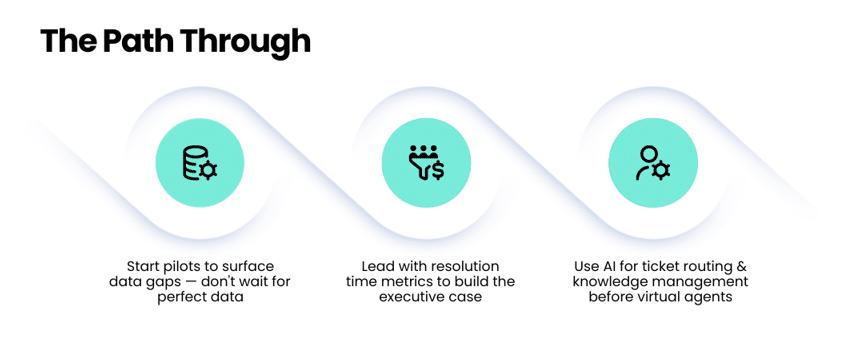
The path through, according to the report:
- Start pilots to surface data gaps — don’t wait for perfect data
- Lead with resolution time metrics to build the executive case
- Use AI for ticket routing and knowledge management before deploying virtual agents
The Top AI ITSM Use Cases Driving ROI (And the Sequence That Actually Works)
Among organizations with widespread AI deployment, the capability picture is highly developed. Here’s where AI in ITSM is being used today:
- Knowledge Article Suggestions and Generation — 88%
- Virtual Agents/Chatbots for End User Support — 82%
- Intelligent Ticket Routing and Classification — 71%
- AI-Assisted Agent Responses — 71%
- Predictive Analytics for Incident Management — 59%
- Automated Ticket Resolution — 35%
- Sentiment Analysis — 29%
Knowledge article generation leads the list, and it’s arguably the most underrated capability relative to ROI delivered. It’s less visible than a customer-facing chatbot, but it consistently delivers faster ROI by addressing the time-consuming knowledge management task that falls to the wayside for stretched teams. It also feeds the downstream AI capabilities (like VSAs) that depend on quality knowledge content to perform accurately.
The report’s deployment sequencing framework reflects this reality:
- Stage 1 (Now): Intelligent Ticket Routing and Classification. Lowest data quality requirement. Immediate SLA and misrouting impact. Begins generating the clean categorization data that downstream capabilities need.
- Stage 2 (3–6 Months): Knowledge Management + AI-Assistance for Technicians. Addresses the highest technician time-cost activity. Builds knowledge base quality that virtual agent deployment depends on. Generates measurable technician-side ROI before any end-user-facing deployment.
- Stage 3 (6–18 Months): Self-Service Virtual Support Agent. Highest executive visibility and deflection ROI — but requires the data quality and knowledge base completeness built in stages 1 and 2. This is where end-user-facing 24/7 support becomes possible at scale.
- Stage 4 (18–36 Months): Predictive Incident and Problem Management. The highest-maturity use case. Requires rich historical data from stages 1–3. Shifts the IT organization from reactive to anticipatory service delivery.
Sequence is strategy. The organizations now experiencing accuracy and reliability problems with their virtual agents are, in large part, organizations that skipped stages 1 and 2.
The Barriers Are Real — But They’re Not What You Think
Budget is cited as the top barrier to AI ITSM adoption by 26% of respondents. But here’s the data that complicates that narrative: not a single respondent in the study reported plans to reduce AI investment. Every organization plans to increase it.
“Lack of budget” in most cases is a proxy for the absence of a sufficiently compelling business case — not the absence of funds. CIOs who have cleared this hurdle consistently describe the same approach: shifting the conversation from technology investment to operational ROI and quantifying the current cost of inaction.
Executive alignment is the other critical factor. Nearly half of all respondents, 48%, describe their executive leadership as neutral, awaiting proof of value. Among organizations that have achieved widespread AI deployment, 73% report a strong C-suite champion. The correlation is not subtle. Executive alignment is the single most reliable differentiator between organizations that reach scale and those that remain in pilot indefinitely.
You can follow this business case structure to build executive support:
- Quantify the cost of the status quo — current ticket volume, resolution time, cost per ticket, first-contact resolution rate, after-hours coverage gap
- Illustrate expected AI impact (peer-benchmarked) — 88% report ticket deflection as a primary outcome; 71% of deployed orgs report faster ticket resolution; 76% report improved customer satisfaction
- Outline the plan for continuous optimization — the AI data quality flywheel that compounds ROI over time
Neutral executives don’t need a vision statement. They need a proof point with a defined measurement date.
What This Means for Your AI ITSM Strategy Right Now
The organizations that will define the next generation of IT service delivery are making their foundational decisions right now. The window to learn from early adopters, rather than repeat their mistakes, is narrower than it’s ever been.
Here’s what the data says separates organizations that scale from those that stall:
- A quantified business case tied to current operational costs, not aspirational efficiency language
- A plan to use AI in ITSM for data clean-up — treating it as an opportunity, not a barrier
- An executive sponsor with visibility into early pilot metrics, even before full deployment
- Use case sequencing that delivers measurable IT-side value before end-user-facing deployment
- Native AI architecture — AI bolted on through middleware consistently underperforms AI native to the ITSM platform
The organizations thriving with AI ITSM are not the ones with the largest budgets. They are the ones who defined what problem they were solving, built the foundation that problem required, sequenced their investments in a rational order, and committed to measuring outcomes from day one.
Ready to Move from Pilot to Production?
The full State of AI in ITSM report includes the complete AI Readiness Framework, the four-stage deployment sequencing guide, the executive business case structure, and the platform evaluation questions every IT leader should be asking before their next ITSM decision.
Download the Full Report: The State of AI in ITSM →
Or explore how TeamDynamix approaches AI in ITSM — including virtual support agents, AI-assisted ticket routing, knowledge management automation, and native AI architecture built for real-world IT constraints — at teamdynamix.com/how-can-we-help/using-ai-itsm-for-faster-resolution/.
Source: TeamDynamix AI in ITSM Market Study, 2026. Survey of 392 IT professionals across 23 industry verticals including healthcare, higher education, financial services, manufacturing, government, and professional services.