



Finding the best ITSM platform for an upper-mid-sized organization means cutting through feature-list noise to focus on what actually matters in day-to-day operation: how fast the tool deploys, how much ongoing admin it demands, and whether it still delivers value two years after go-live. This shortlist of modern service desk tools covers the platforms most frequently evaluated by IT leaders in 2025–2026 — ranked to help you build a credible shortlist, not to sell you on any single vendor.
The platforms below were selected based on analyst recognition (Info-Tech Research Group and Gartner®), verified user review data, and buyer-reported attributes, including admin overhead, time to value, configurability without code, and ticket deflection capability. Each entry follows a consistent structure so you can compare vendors on the dimensions that matter most to your team.
Quick answer (updated October 2026): TeamDynamix is the no-code option with the lowest admin overhead and built-in ITAM. ServiceNow offers the broadest feature depth at the highest cost and admin load. Jira Service Management suits Atlassian shops, and Freshservice suits smaller teams.
ITSM Vendor Comparison Table
| Vendor | Gartner 2026 ITSM Magic Quadrant | Info-Tech Composite Score | Likely to Recommend | Admin Overhead | Deployment Speed | Best Fit | Configuration Model |
| TeamDynamix | Challenger | 8.7 (Enterprise) | 90% | Low | Days to weeks | Enterprise | No-code |
| ServiceNow | Leader | 8.5 (Enterprise) | 86% | High | Months to years | Large enterprise | Code heavy/ professional services |
| Ivanti | Niche Player | 7.9 (Enterprise) | 85% | Medium | Weeks to months | Mid-to-large enterprise | GUI + scripting |
| Jira Service Management | Leader | 8.7 (Midmarket) | Not stated | Low | Days to weeks | DevOps teams, Atlassian shops | Low-code/ scripting optional |
| Freshservice | Leader | 8.3 (Midmarket) | Not stated | Medium | Days to weeks | SMB, small IT teams | Low-code/ GUI |
#1 — TeamDynamix ITSM
Best for: Enterprise companies seeking a no-code ITSM platform with low admin overhead, AI agents, and enterprise orchestration with integration.
TeamDynamix is a no-code, AI-powered platform that unifies ITSM, Enterprise Service Management (ESM), Project Portfolio Management (PPM), and IT Asset Management (ITAM) with AI Virtual Support Agents and enterprise integration and automation without the complexity.
TeamDynamix was recently named a Challenger in the 2026 Gartner® Magic Quadrant™ for IT Service Management (ITSM) Platforms, and sits at the top of the Info-Tech 2026 Enterprise ITSM Data Quadrant, and the numbers back it up. With a Composite Score of 8.7, a Customer Experience Score of 9.0, and 90% of users saying they’d recommend it to a colleague, TeamDynamix consistently outperforms the competition where it matters most: the actual working relationship between vendor and customer.
What sets TeamDynamix apart is its no-code philosophy. IT teams can stand up new workflows, automations, and integrations without involving developers. AI capabilities are baked in — not bolted on — with Virtual Service Agents that deflect 30–60% of tickets and AI Service Assist that cuts resolution time by 40–90%, making TeamDynamix the best ITSM tool for reducing ticket volume. With AI ITSM companies can leverage AI for triage, KB content creation, form building, workflow building, and integration building. The platform unifies ITSM, ESM, PPM, ITAM, and iPaaS in a single environment, dramatically reducing total cost of ownership. Gartner specifically called out TeamDynamix’s automation and orchestration abilities as strengths. In addition, Gartner listed close customer relationships, outcome-focused selling, and flexible licensing as strengths. You can download the full report here. This sets TeamDynamix apart as the best IT service desk software for modern IT teams.
For Info-Tech, users report top scores for how TeamDynamix treats them during contracts (+92 for Generous vs. Greedy), service interactions (+99 for Respectful vs. Disrespectful), and conflict resolution (+98 for Trustworthy). It earned a 96% Most Loved rating — the highest of any vendor in its category.
Key Stats (2026 ITSM Vendor Comparison Report, 2026 Gartner® Magic Quadrant™ for IT Service Management (ITSM) Platforms)
- Composite Score: 8.7 / 10
- Customer Experience Score: 9.0 / 10
- Likeliness to Recommend: 90%
- Most Loved Rating: 96%
- Net Emotional Footprint: +93
- Business Value Satisfaction: 85%
- Product Strategy Satisfaction: 83%
- Ease of Implementation: 84%
- Vendor Training Satisfaction: 84%
Pros:
- No. 1 in Info-Tech 2026 Enterprise ITSM Data Quadrant
- 96% Most Loved — highest in the ITSM category
- Unified no-code platform: ITSM, ESM, PPM, ITAM, AI VSAs, iPaaS
- 30–60% ticket deflection with AI Virtual Service Agents
- 40–90% faster resolution with AI ITSM
- Top-rated for contracts, service, and conflict resolution
- Positioned as a Challenger in the 2026 Gartner Magic Quadrant for ITSM Platforms
- Recognized by Gartner for close customer relationships, outcome-focused selling, and flexible licensing
Cons:
- Better suited enterprise organizations — smaller teams may not need as much power.
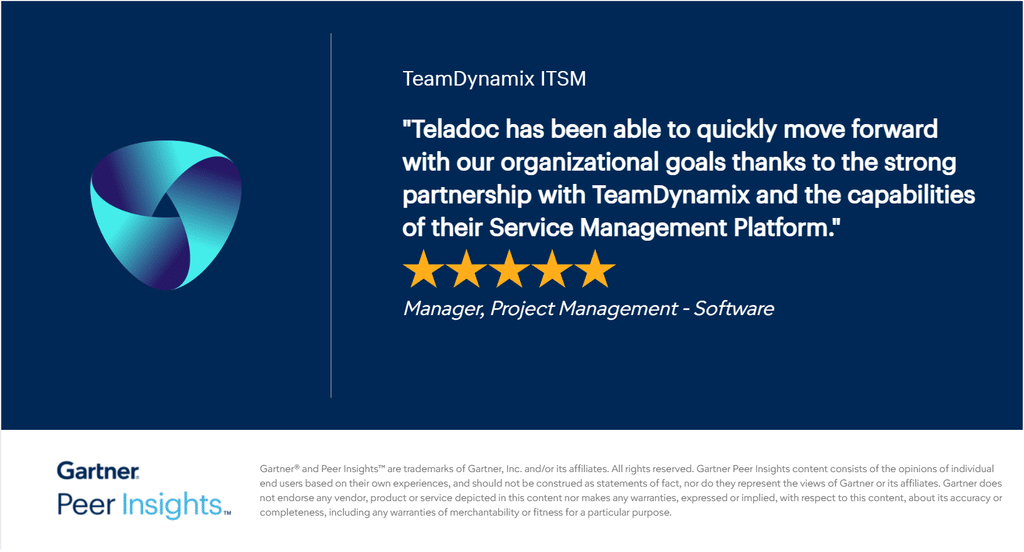
Check out TeamDynamix reviews on Gartner Peer Insight.
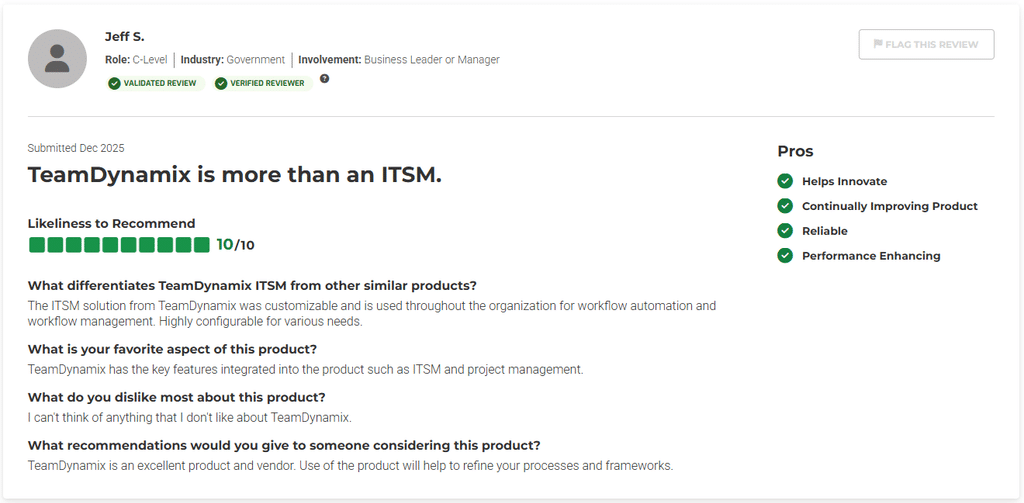
Check out TeamDynamix reviews on Info-Tech’s SoftwareReviews.
#2 — ServiceNow ITSM
Best for: Large enterprises with complex, multi-department service management needs and substantial IT budgets.
ServiceNow is the name most IT leaders already know. It’s a mature, feature-rich platform that excels at giving large enterprises end-to-end visibility across IT processes through a single system of record. With a Composite Score of 8.5 and an 86% recommendation rate, it delivers strong performance — though the customer experience story is more complicated.
Where ServiceNow earns high marks for features and ITIL support, users are more guarded about the vendor relationship. Contract negotiations scored +71 for Generous vs. Greedy — notably lower than competitors — and a 77% product strategy satisfaction suggests room to grow on innovation pace. For large teams that need deep process coverage and broad ecosystem integrations, ServiceNow remains a proven choice.
Key Stats (2026 ITSM Vendor Comparison Report, 2026 Gartner® Magic Quadrant™ for IT Service Management (ITSM) Platforms)
- Composite Score: 8.5 / 10
- Customer Experience Score: 8.6 / 10
- Likeliness to Recommend: 86%
- Most Loved Rating: 90%
- Net Emotional Footprint: +83
- Satisfaction of Cost Relative to Value: 78%
Pros:
- Comprehensive feature set for large-scale ITSM
- Strong Data Quadrant placement as a Leader
- Deep ITIL alignment and broad process coverage
- Wide third-party integration ecosystem
- Named a Leader in the 2026 Gartner Magic Quadrant for ITSM Platforms
Cons:
- Among the highest total cost of ownership in the category according to both Gartner and Info-Tech
- Gartner also cautions that many customers struggle to realize and show the platform’s value
#3 — Ivanti Neurons for ITSM
Best for: Organizations that do not need a complete ITSM/ESM platform with DEX, ITAM, and enterprise orchestration on one platform.
Ivanti Neurons for ITSM is a cloud-first platform that automates workflows to eliminate manual processing and improve efficiency, security, and compliance.
Ivanti has a Composite Score of 7.9 and an 85% recommendation rate. The company scores well on service dimensions like Efficient vs. Bureaucratic (+86) and conflict resolution (Trustworthy: +93).
Key Stats (2026 ITSM Vendor Comparison Report, 2026 Gartner® Magic Quadrant™ for IT Service Management (ITSM) Platforms)
- Composite Score: 7.9 / 10
- Customer Experience Score: 8.2 / 10
- Likeliness to Recommend: 85%
- Most Loved Rating: 89%
- Net Emotional Footprint: +87
- Named a Niche Player in the 2026 Gartner Magic Quadrant for ITSM Platform
Pros:
- Cloud-optimized with workflow automation
- Flexible — scales from basic ticketing to full ITIL
- Strong conflict resolution scores (Trustworthy: +93)
Cons:
- Lower Composite Score (7.9) than top-tier competitors
- Usability satisfaction (78%) trails leading platforms
- Gartner cautions that the company’s roadmap has a new feature lag and customer retention challenges
#4 — Atlassian Jira Service Management
Best for: DevOps teams and Atlassian-embedded organizations that want to unify IT operations and software development in a single environment.
Jira Service Management earns a Composite Score of 8.7 in the Info-Tech Midmarket ITSM category — but doesn’t meet the criteria to appear on the 2026 Info-Tech Enterprise ITSM Data Quadrant. Users consistently describe the balance of ease of use and modern UI as a strength, with the native integration between JSM and Jira Software acting as a force multiplier for teams already embedded in the Atlassian ecosystem.
Key Stats (2026 ITSM Vendor Comparison, Mid-Market, 2026 Gartner® Magic Quadrant™ for IT Service Management (ITSM) Platforms)
- Composite Score: 8.7 / 10
- CX Score: 8.8 / 10
- Data Quadrant Award: Champion, ITSM Midmarket 2026
- Named a Leader in the 2026 Gartner Magic Quadrant for ITSM Platforms
Pros:
- Composite score of 8.7 — among the highest in the ITSM Midmarket category
- Deep Atlassian ecosystem integration with Jira Software, Confluence, and Marketplace
Cons:
- Did not meet criteria for inclusion on the Info-Tech Enterprise ITSM Data Quadrant
- Less suited for organizations outside the Atlassian ecosystem
- Gartner calls out customization needs as a caution
#5 — Freshservice
Best for: SMBs and smaller IT teams wanting a clean, easy-to-deploy cloud ITSM platform.
Freshservice earns a composite score of 8.3 in the Info-Tech Midmarket ITSM category, backed by 66 verified reviews. Like Jira, Freshservice did not meet the criteria for the 2026 Info-Tech Enterprise ITSM Data Quadrant. Small teams may find this ITSM a good fit.
Key Stats (2026 ITSM Vendor Comparison, Mid-Market, 2026 Gartner® Magic Quadrant™ for IT Service Management (ITSM) Platforms)
- Composite Score: 8.3 / 10
- CX Score: 8.4 / 10
- Named a Leader in the 2026 Gartner ITSM Magic Quadrant for ITSM PLatforms
Pros:
- Clean, intuitive interface for both agents and end users
- Good fit and competitive price point for smaller organizations
Cons:
- Some advanced analytics and capabilities require higher-tier plans
- Less depth for complex enterprise deployments
- Gartner lists potential cost overruns and murky support for customers on the standard tier as cautions
How to Choose an ITSM Platform: Key Evaluation Criteria
Before reviewing individual tools, align your team on the criteria that most predict long-term satisfaction:
- Admin overhead — How much dedicated admin effort does the platform require post-deployment? Can IT generalists manage it without heavy scripting?
- Time to value — Does the platform deploy in days to weeks, or does it require months of professional services before users see results?
- Upper-Mid-market fit — Is the platform sized appropriately for teams of 50–500 IT staff, or is it built for Fortune 500 complexity?
- Configurability without code — Can workflows, automations, and forms be adjusted through no-code interfaces, or does every change require a developer?
- Ticket deflection — Does the platform include self-service and AI capabilities that meaningfully reduce inbound ticket volume?
- Total cost of ownership (TCO) — What does the platform actually cost when implementation, licensing tiers, integration work, and ongoing admin are factored in?
Don’t Just Pick a Platform, Pick a Partner
Choosing an ITSM platform is one of the most consequential decisions an IT team makes — and it’s one you’ll live with for years. The tools on this list have all earned their place through verified user feedback, not marketing spend. But the right answer isn’t the same for every organization.
For enterprise organizations that need fast time to value, low ongoing admin burden, and a platform that IT generalists can manage without scripting, the shortlist narrows quickly — with the right pick depending on whether you need unified ITSM+PPM, simplicity at small scale, or DevOps alignment.
For large enterprises with dedicated admin staff and complex process requirements, ServiceNow remains the established benchmark — but buyers should evaluate TCO carefully and scrutinize vendor relationship terms before committing.
Whichever platform you shortlist, evaluate it against the criteria that predict satisfaction two to three years in: how much admin it requires, whether it deploys in days or months, and whether the vendor relationship holds up when things get complicated.
If you want to see how TeamDynamix measures up for your specific environment, request a demo or download the full 2026 Info-Tech ITSM Comparison Report. You can also read through the 2026 Gartner Magic Quadrant for IT Service Management Platforms report.
Frequently Asked Questions
TeamDynamix ITSM ranks first, based on analyst recognition from Info-Tech Research Group and Gartner, along with verified user review data. It’s positioned as a Challenger in the 2026 Gartner Magic Quadrant for ITSM Platforms and sits at the top of the Info-Tech 2026 Enterprise ITSM Data Quadrant.
TeamDynamix is generally considered the established choice for enterprises with complex, multi-department service needs, yet a desire for low admin overhead and a rapid time to value. Its mature feature set and deep ITIL alignment, along with its automation, orchestration and integration layer enable IT teams to truly take advantage of AI across the entire IT service operation.
Freshservice is positioned as a strong fit for smaller IT teams and SMBs that want an easy-to-deploy, clean cloud ITSM platform at a competitive price point, though some advanced features may require higher-tier plans.
Atlassian Jira Service Management is well suited to DevOps teams and organizations already embedded in the Atlassian ecosystem, since it integrates natively with Jira Software, Confluence, and the Atlassian Marketplace.
Key evaluation criteria include admin overhead, time to value, fit for enterprise scale, configurability without code, ticket deflection capability, and total cost of ownership once implementation, licensing, and ongoing admin are factored in.
Ticket deflection reflects how much a platform’s self-service and AI capabilities reduce inbound ticket volume. For example, TeamDynamix’s AI Virtual Service Agents are reported to deflect between 30 and 60 percent of tickets, with AI Service Assist cutting resolution time by 40 to 90 percent.
The rankings draw on the 2026 IT Service Management Enterprise and Midmarket Data Quadrant categories from Info-Tech Research Group, verified end-user reviews, and the 2026 Gartner Magic Quadrant for IT Service Management Platforms.
Not necessarily. Composite Score is one useful signal, but the right platform depends on organization size, budget, in-house admin capacity, and whether workflows need no-code configurability or can support a code-heavy, professional-services-driven deployment.
A note about sources
All Info-Tech data is sourced from the 2026 IT Service Management Enterprise and Midmarket Data Quadrant categories published by Info-Tech Research Group, available at infotech.com/software-reviews/categories/it-service-management-enterprise. Scores reflect verified end-user reviews. To download the full 2026 Info-Tech ITSM Comparison Report, visit: https://www.teamdynamix.com/itsm-vendor/
Gartner Disclaimer
Gartner does not endorse any company, vendor, product or service depicted in its publications, and does not advise technology users to select only those vendors with the highest ratings or other designation. Gartner publications consist of the opinions of Gartner’s business and technology insights organization and should not be construed as statements of fact. Gartner disclaims all warranties, expressed or implied, with respect to this publication, including any warranties of merchantability or fitness for a particular purpose.
GARTNER is a trademark of Gartner, Inc. and/or its affiliates. Magic Quadrant is a registered trademark of Gartner, Inc. and/or its affiliates and is used herein with permission. All rights reserved.