


Jira is strong for Agile teams, but portfolio and resource planning needs plug-ins or its Premium tier. TeamDynamix includes native portfolio, program, and resource capacity planning for both Agile and Waterfall out of the box.

TeamDynamix positioned as a Challenger in 2026 Gartner® Magic Quadrant™ for IT Service Management (ITSM) Platforms
When we talk to IT leaders using JIRA (JSM) for the service desk, we often hear frustration. They say the platform requires a lot of admin overhead and oversight to make it work for IT Service Management. Automation often needs to be coded; ESM expansion hits obstacles due to high IT admin burden; and reporting requires JQL, making it difficult to do ad hoc reporting or to create custom views. TeamDynamix can help.
Automation Needs Forge Code
ESM Requires IT Admin Burden
Reporting Requires JQL
Atlassian invests heavily in R&D and protects that investment through a broad patent portfolio, which lets it move fast on new capability — recent additions include portal-based live chat, AI-generated playbooks, and Rovo AI. For organizations already using Confluence, Bitbucket, or Trello, and with development teams comfortable extending the platform through Forge, Jira Service Management offers a genuinely unified experience across dev and IT operations.
Where the Trade-offs Show Up
Most meaningful automation requires code, not clicks. Jira Service Management’s native automations only work with Atlassian products. The moment a workflow needs to touch Workday, an IAM system, Active Directory, or virtually any external enterprise system, it requires custom Forge development (JavaScript/TypeScript) or a third-party integration platform. Joiner/mover/leaver lifecycle automation, password reset with identity verification, and license reclamation all become development projects rather than admin configuration
Hard execution limits show up at real-world scale. Automation can fail silently once you hit a limit. Jira enforces execution caps on its automation engine, and whether those caps loosen or tighten by pricing tier is worth confirming directly with Atlassian. What’s consistent is the failure mode: a workflow that exceeds a limit doesn’t error out; it just stops mid-run — and nothing alerts anyone unless that alert has been built in advance.
Atlassian’s Jira vs. TeamDynamix:
What should you consider?
Atlassian requires Forge development to reach outside its own products. TeamDynamix ships 200+ out-of-the-box connectors with a no-code custom connector builder.
Atlassian’s automation carries execution limits that can make it harder to scale. TeamDynamix imposes no practical automation ceiling.
Atlassian requires JQL fluency for most useful reports. TeamDynamix offers a visual report builder — no query language required.
Configuring workflows, forms, and screens for a department’s JSM project typically routes through a central Jira admin rather than the department itself due to the admin complexity. Scaling service management across other departments like HR, Legal, and Facilities means either building admin capacity centrally for every department’s needs or extending broader permissions than most organizations are comfortable granting. TeamDynamix’s easy-to-operate distributed administration model lets each department manage its own application without needing platform-admin involvement.
The end-of-sale for Data Center offerings, the introduction of consumption-based pricing for AI and assets, and recurring annual price increases have all been flagged as causing budgeting issues for customers unfamiliar with Atlassian’s pricing model.
Are You Looking to Compare ITSM Vendors?
You’ve been led to believe there are two platform choices: simple and limited, or powerful with added costs and complexity. Those aren’t choices; they’re trade-offs. That’s why, according to Gartner, 8 in 10 IT buyers overspend on their ITSM platform.
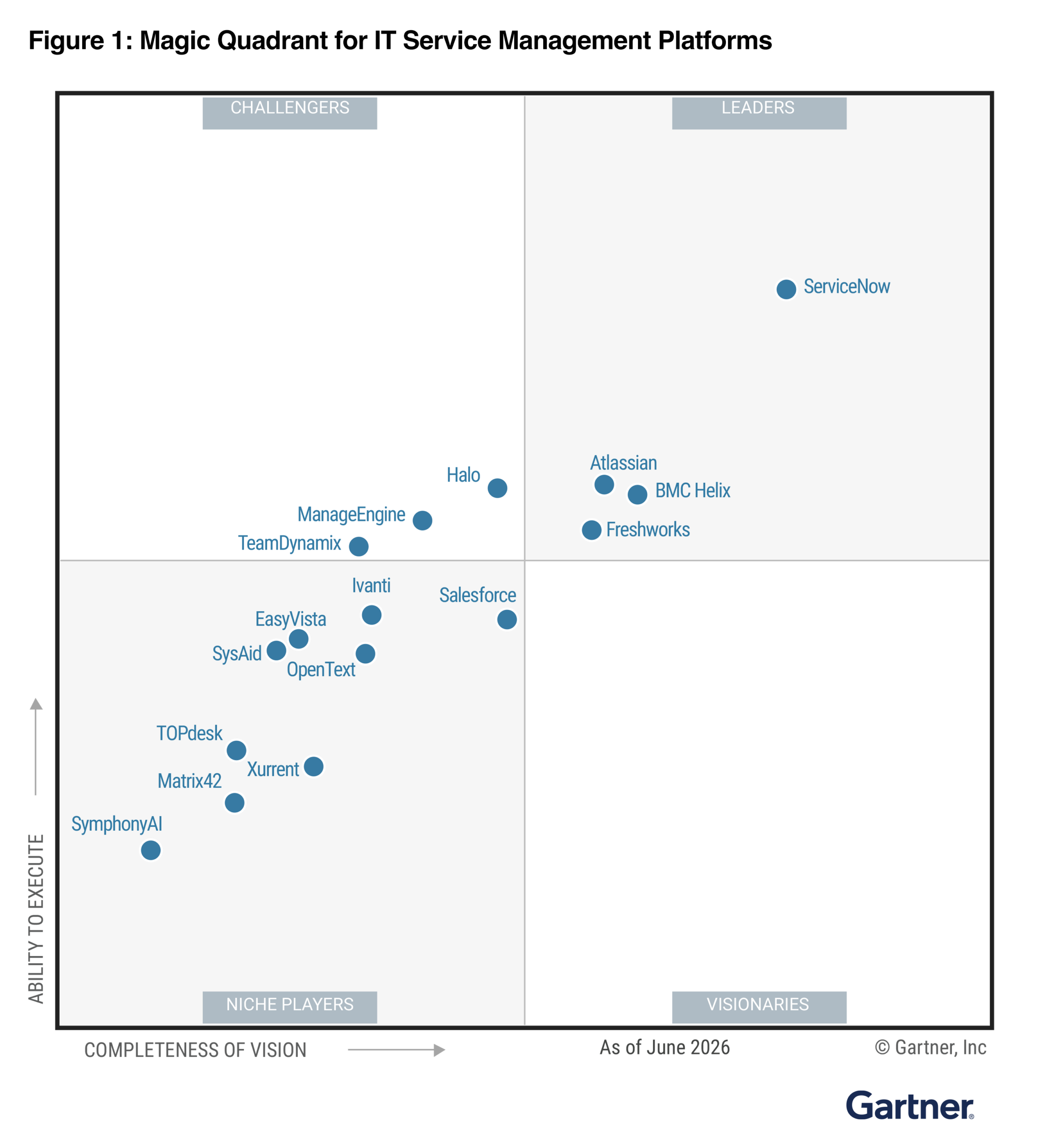
The 2026 Gartner® Magic Quadrant™ for IT Service Management (ITSM) Platforms report evaluates ITSM vendors across the market on their Ability to Execute and Completeness of Vision. Get your complimentary copy of the report today.
TeamDynamix is focused on continuous process improvement, helping customers to achieve measurable results. Our 98% customer retention rate reflects an ITSM platform that’s built to evolve with your business, delivering agility and adaptability.
For many years, the ITSM market had everyone believing that if they wanted ITSM power, they needed to invest heavily in developers and a cumbersome platform. This is a false trade-off.

CUSTOMER STORY

CUSTOMER STORY




The main difference is how each platform handles automation once a workflow needs to leave its own ecosystem. TeamDynamix uses a no-code visual workflow builder with 200+ out-of-the-box connectors. Atlassian Jira’s native automations only work with Atlassian products — reaching Workday, an IAM system, or Active Directory requires custom Forge development.
Yes, for anything outside Atlassian’s own products. Common enterprise patterns — joiner/mover/leaver lifecycle automation, password reset with identity verification, license reclamation — all become development projects requiring Forge (JavaScript/TypeScript) rather than admin configuration.
No. TeamDynamix uses a fully no-code visual workflow builder, so teams can design and deploy automations by connecting steps visually rather than writing code.
Jira enforces execution caps on its automation engine, and whether those caps loosen or tighten by pricing tier is worth confirming directly with Atlassian. What’s consistent is the failure mode: a workflow that exceeds a limit doesn’t error out, it just stops mid-run — and nothing alerts anyone unless that alert has been built in advance.
Multi-department service management in Jira means separate “sites” (instances) per department, which makes cross-organizational processes and unified reporting genuinely difficult. TeamDynamix offers unified enterprise reporting across all departments from a single platform.
Yes. Most useful reports require JQL (Jira Query Language) expertise — a real barrier for the non-technical managers who most need visibility into service performance. TeamDynamix uses a visual report builder that requires no query language.
Recent licensing shifts have created budget uncertainty. The end-of-sale for Data Center offerings, the introduction of consumption-based pricing for AI and assets, and recurring annual price increases have all been flagged as causing budgeting issues for customers unfamiliar with Atlassian’s pricing model.
Jira is strong for Agile teams, but portfolio and resource planning needs plug-ins or its Premium tier. TeamDynamix includes native portfolio, program, and resource capacity planning for both Agile and Waterfall out of the box.
Yes. Atlassian was named a Leader and TeamDynamix a Challenger in the 2026 Gartner® Magic Quadrant™ for IT Service Management Platforms.
OUR SOLUTIONS
Drive agility in service management with AI and automation. Leverage a full-lifecycle AI-powered ITSM/ESM platform with support for ITIL, change management, assets, virtual support agents, and more.
Supercharge service and reduce admin overhead by leveraging no-code IT Service Management built to evolve and scale.
Make enterprise service management a reality with a single platform across IT, facilities, HR, marketing and more.
Cut software costs, stay compliant and expedite service delivery with real-time insights and usage data for all assets.
Project Portfolio Management helps improve team collaboration and resource capacity planning.
Digital Employee Experience (DEX) helps IT monitor, detect, and remediate computer issues before they become problems. Deflect endpoint-related tickets and gain visibility to expedite ticket resolution.
Let automation take off with no-code enterprise integration and workflow. Eliminate manual work and improve connectivity with a library of prebuilt connectors and a visual flow builder.
Unlock the power of seamless service delivery, intelligent AI solutions and automated efficiency. Take your enterprise to new heights with TeamDynamix.