


You can check out Gartner’s 2026 Magic Quadrant for IT Service Management Platforms and InfoTech’s ITSM vendor quadrant as third-party sources for comparing the two platforms. As well as review sites like SoftwareReviews and Gartner Peer Insights.

TeamDynamix positioned as a Challenger in 2026 Gartner® Magic Quadrant™ for IT Service Management (ITSM) Platforms
When we work with ServiceNow shops, we hear three things over and over again: it’s a costly platform that requires high admin overhead; it can take months to deploy new automations or workflows; and the platform itself is very expensive, with additional costs piling on each year.
IT leaders are looking for ITSM power without the complexity. TeamDynamix can help.
Requires 8-10 Platform Admins
Time to Value is Elongated
Platform Tax and Hidded Costs
ServiceNow is the undisputed heavyweight of the ITSM market — and for large, complex enterprises with dedicated platform teams, it earns that position. But for the upper mid-market (500–15,000 employees), ServiceNow’s power often comes bundled with a developer dependency and a cost structure that’s grown more complex, not less. In comparison, TeamDynamix was built to deliver comparable depth without requiring a standing development team to operate it.
Where the Trade-offs Show Up
Workflow changes require developers, not admins. ServiceNow’s Flow Designer is powerful, but building anything beyond a basic approval routing means subflows, script includes, transform maps, and business rules, which require technical skills. For organizations without ServiceNow developers on staff, every workflow change becomes a project, which means additional costs and extended timelines to get out basic automations.
AI pricing changed in April 2026 — and got more complex. ServiceNow’s new tier structure bundles AI into every tier, but usage is now metered through “Assist” tokens, with three separate consumption meters (Assists, Data Fabric tokens, Build Agent calls) that interact in ways that are genuinely difficult to project.
ServiceNow vs. TeamDynamix:
What should you consider?
ServiceNow requires complex subflows/scripting and has a high level of dev or partner dependency. In comparison, TeamDynamix offers a no-code visual flow builder that allows non-technical admis to build and deploy independently.
ServiceNow has a consumption-based AI pricing model with “assist” tokens that carry overage risk across three different meters. TeamDynamix has bundled AI with the core ITSM product license for technician assist and offers VSA at as an additional license with a flat predictable price.
ServiceNow requires separate ITOM discovery licensing + MID Server + months-long rollout and associated costs. With TeamDynamix you have native observabiltiy connectors to Datadog, Splunk, New Relic) which automatically populate the CMDB.
Platform cost start to compound as do rollout timeframes when you start to add ITAM to the core ITSM platform in ServiceNow. In comparison, TeamDynaix offers an integrate ITAM (SAM/HAM) solution that is highly competitive in terms of pricing and much more simple to deploy. Many ServiceNow shops will opt to use TeamDynamix ITAM even with their ServiceNow solution as it can be deployd as a separate solution if desired.
Are You Looking to Compare ITSM Vendors?
You’ve been led to believe there are two platform choices: simple and limited, or powerful with added costs and complexity. Those aren’t choices; they’re trade-offs. That’s why, according to Gartner, 8 in 10 IT buyers overspend on their ITSM platform.
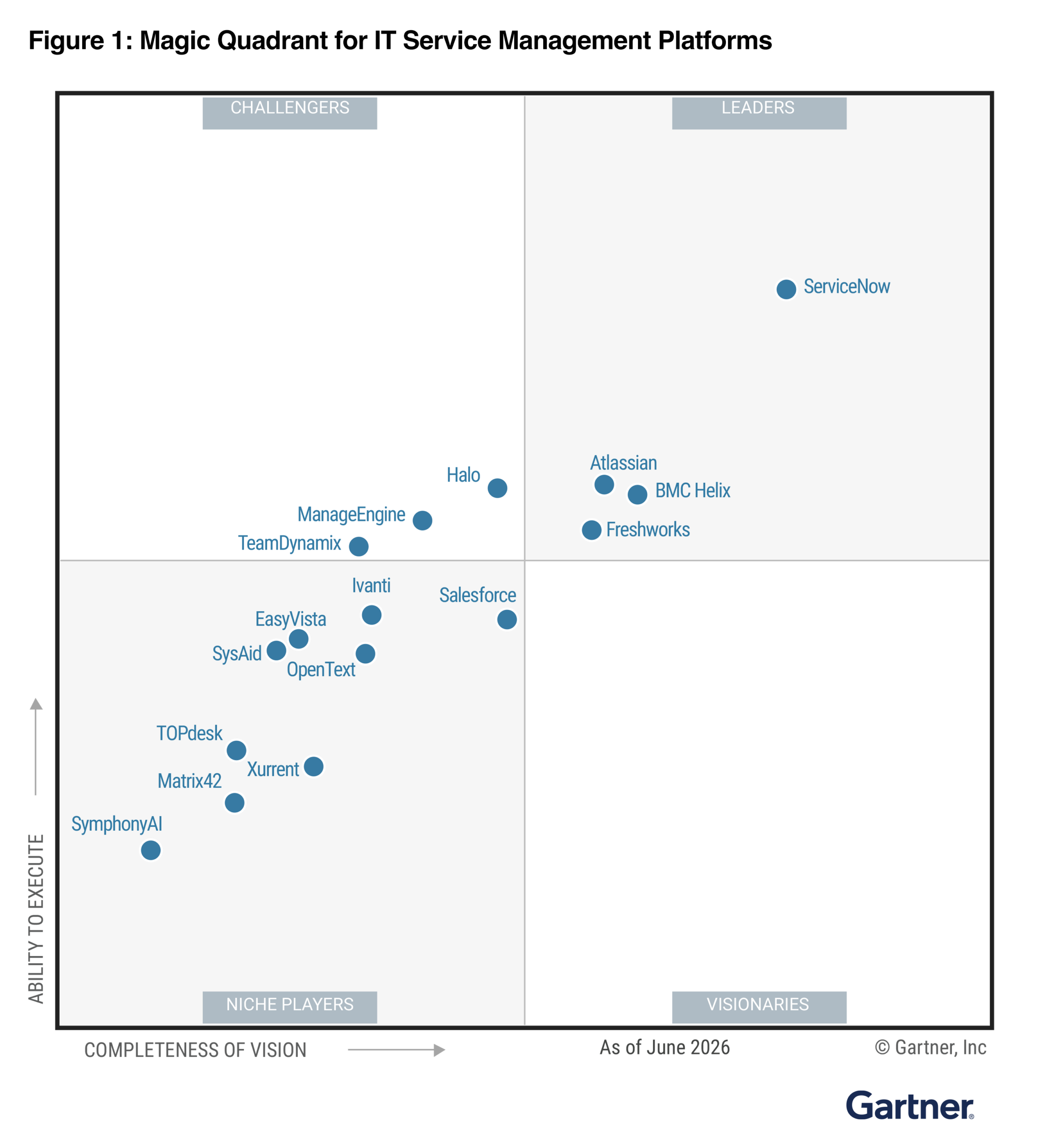
The 2026 Gartner® Magic Quadrant™ for IT Service Management (ITSM) Platforms report evaluates ITSM vendors across the market on their Ability to Execute and Completeness of Vision. Get your complimentary copy of the report today.
TeamDynamix is focused on continuous process improvement, helping customers to achieve measurable results. Our 98% customer retention rate reflects an ITSM platform that’s built to evolve with your business, delivering agility and adaptability.
For many years, the ITSM market had everyone believing that if they wanted ITSM power, they needed to invest heavily in developers and a cumbersome platform. This is a false trade-off.

CUSTOMER STORY

CUSTOMER STORY




Yes. TeamDynamix is positioned as a no-code ITSM/ESM alternative to ServiceNow for organizations that want lower admin overhead and faster deployment. It targets upper-mid-market and enterprise IT teams that find ServiceNow’s code-heavy configuration model too resource-intensive to maintain.
The core difference is the configuration model. ServiceNow uses a code-heavy, professional-services-driven approach, while TeamDynamix uses a no-code platform. This translates directly into admin overhead (high vs. low) and deployment speed (weeks-to-months vs. days-to-weeks).
TeamDynamix has low admin overhead, deploys in days to weeks, and is best suited for upper-mid-market and enterprise organizations, using a no-code configuration model. ServiceNow has high admin overhead, deploys in weeks to months, and is best suited for large enterprise, using a code-heavy, professional-services-driven configuration model. Ivanti has medium admin overhead, deploys in weeks, and is best suited for mid-to-large enterprise, using a GUI-plus-scripting model. Jira Service Management has low admin overhead, deploys in days to weeks, and is best suited for DevOps teams and Atlassian shops, using a low-code model with optional scripting. Freshservice has medium admin overhead, deploys in days to weeks, and is best suited for SMBs and small IT teams, using a low-code/GUI model.
The most commonly cited reason is admin overhead: ServiceNow often requires dedicated developers or paid consultants for even minor workflow changes, driving up cost and slowing time-to-value. Customers report that changes taking weeks and costing tens of thousands of dollars on ServiceNow were completed in a single day on TeamDynamix at no extra cost.
No. TeamDynamix is a no-code platform, meaning IT teams can build custom forms, automated workflows, and integrations without developer resources — a contrast to ServiceNow’s code-heavy model, which often requires specialized administrators or consultants.
Both are positioned for enterprise use, but TeamDynamix specifically targets upper-mid-market and enterprise organizations that want ServiceNow-level ITSM/ESM capability without ServiceNow’s administrative complexity. ServiceNow itself is generally positioned toward large enterprise deployments with dedicated implementation teams.
TeamDynamix emphasizes lower total cost of ownership driven by reduced admin overhead rather than licensing price alone. As one example cited on the page, a Microsoft Exchange integration quoted at $50,000 on ServiceNow was completed in an afternoon on TeamDynamix at no additional cost. Exact pricing depends on contract specifics, which aren’t published.
TeamDynamix offers a unified no-code platform spanning ITSM, ITAM (IT Asset Management), ESM (Enterprise Service Management), PPM (Project Portfolio Management), a Conversational AI virtual agent, and iPaaS (integration/automation with a connector library) – all on one platform, nothing bolted on.
You can check out Gartner’s 2026 Magic Quadrant for IT Service Management Platforms and InfoTech’s ITSM vendor quadrant as third-party sources for comparing the two platforms. As well as review sites like SoftwareReviews and Gartner Peer Insights.
OUR SOLUTIONS
Drive agility in service management with AI and automation. Leverage a full-lifecycle AI-powered ITSM/ESM platform with support for ITIL, change management, assets, virtual support agents, and more.
Supercharge service and reduce admin overhead by leveraging no-code IT Service Management built to evolve and scale.
Make enterprise service management a reality with a single platform across IT, facilities, HR, marketing and more.
Cut software costs, stay compliant and expedite service delivery with real-time insights and usage data for all assets.
Project Portfolio Management helps improve team collaboration and resource capacity planning.
Digital Employee Experience (DEX) helps IT monitor, detect, and remediate computer issues before they become problems. Deflect endpoint-related tickets and gain visibility to expedite ticket resolution.
Let automation take off with no-code enterprise integration and workflow. Eliminate manual work and improve connectivity with a library of prebuilt connectors and a visual flow builder.
Unlock the power of seamless service delivery, intelligent AI solutions and automated efficiency. Take your enterprise to new heights with TeamDynamix.