Halo vs. TeamDynamix

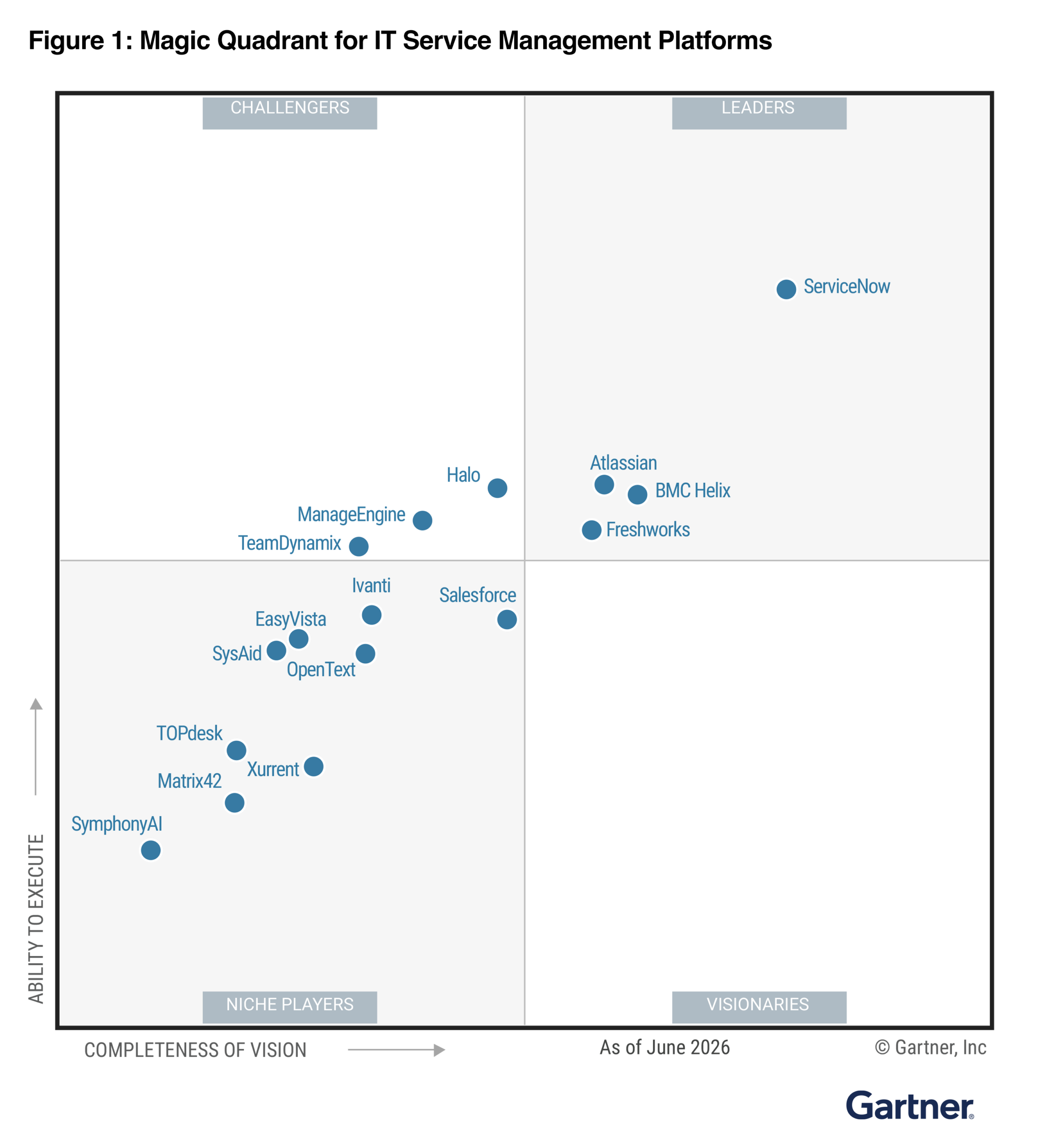
TeamDynamix and Halo are the two closest Challengers in the 2026 Gartner® Magic Quadrant™ for IT Service Management Platforms — which makes the operational differences between them worth looking at closely.

How Does Halo Compare to the Alternatives for IT Service Management?

Automation Needs Scripting

Permissions Gap with AI Chat

API Limits Hamper Automation

No-code ITSM is changing how the market thinks about automation — making it possible to get all of the platform's power without hiring a team to build scripts or code.

How Does Halo Compare to TeamDynamix?

Halo’s single-SKU pricing is a real differentiator — it removes a lot of the budget uncertainty that shows up elsewhere in this market. But for small, technically capable IT teams, that predictability comes with a catch: realizing Halo’s advanced value requires scripting skills, and for full AI capability, standing up and managing your own Azure OpenAI and vector database infrastructure.


Where the Trade-offs Show Up


Most meaningful configuration requires code, not clicks. Halo automations run through “runbooks” — custom, API-based integrations requiring knowledge of webhooks, SQL statements, JSON payloads, and scripting languages like PowerShell. Independent assessment describes this as workable for small technical teams doing simple automations, but breaking down for larger organizations. Realistically, that means budgeting for 2–3 dedicated script/SQL/JSON specialists just to build and maintain integrations.


Most AI capability requires you to run your own AI infrastructure. Only 3–4 of Halo’s 14 AI features work with its included default AI connection. The rest — including AI knowledge search, article suggestions, ticket matching, and custom virtual agent capability — require customers to bring and manage their own Azure OpenAI account and Azure AI Search infrastructure. That’s not a flexibility option; it’s a transfer of AI operations cost, effort, and risk onto the customer.

Halo vs. TeamDynamix:

What should you consider?

Workflow and Automation

Halo requires scripting and low-level dev/admin work. TeamDynamix offers a no-code visual builder to deploy and design independently.

AI Infrastructure

Most Halo AI is BYOK on your own Azure stack. TeamDynamix AI is fully managed and included — no infrastructure to stand up.

AI Grounding

Halo leans on generic LLM inference. TeamDynamix uses supervised ML trained on each customer’s own ticket history.

Permissions Gap

Halo’s virtual agent can bypass the reporting permissions model, exposing data users can’t normally see. TeamDynamix respects platform permission boundaries.

CMDB, ITAM, and API limits add up. Consider how bolt-on purchases and rate ceilings shape your total cost and technical strategy over time.

Full CMDB/ITAM requires a separate Virima purchase

Basic asset tracking is included, but real software and hardware asset management depends on a third-party product relationship, adding cost and a second support path.

API rate limits constrain automation at moderate scale

A hard limit of 500 API requests per 3-minute window means a single automation touching 500 tickets can consume the entire limit. Halo’s own guidance recommends batching in groups of 200–300 items to work around it.

See TeamDynamix Live

2026 Gartner Magic Quadrant for IT Service Management Platforms
GARTNER IT SERVICE MANAGEMENT MAGIC QUADRANT

Gartner® Magic Quadrant™ for
IT Service Management (ITSM)
Platforms

The 2026 Gartner® Magic Quadrant™ for IT Service Management (ITSM) Platforms report evaluates ITSM vendors across the market on their Ability to Execute and Completeness of Vision. Get your complimentary copy of the report today.

What are Customers Saying About TeamDynamix?

TeamDynamix is focused on continuous process improvement, helping customers to achieve measurable results. Our 98% customer retention rate reflects an ITSM platform that’s built to evolve with your business, delivering agility and adaptability. 

For many years, the ITSM market had everyone believing that if they wanted ITSM power, they needed to invest heavily in developers and a cumbersome platform. This is a false trade-off.

TeamDynamix
ends the trade-off.

CUSTOMER STORY

Casino Arizona Deploys Enterprise Service with Low Admin Overhead

ITSM for Hospitality

CUSTOMER STORY

San Francisco Health Plan Transforms IT Operations with Smart Service Management and Automation

Healthcare Smart Service Management

CUSTOMER STORY

Faith Regional Health Services Overcomes Resource Constraints with Integrated Service Management

Faith Regional Health Services Overcomes Resource Constraints

CUSTOMER STORY

No-Code Service Management Platform Pays Dividends for Stockman Bank

ServiceNow ITSM Alternatives for Financial Services

CUSTOMER STORY

Why Three Service Teams Chose TeamDynamix Over ServiceNow

no-code ITSM and digital transformation

CUSTOMER STORY

From ITSM to ESM: How One Agency Achieved ‘Insane’ ROI in 10 Months

Embracing Enterprise Service Management in the Public Sector

Frequently Asked Questions

What's the main difference between TeamDynamix and Halo ITSM?

The main difference is how each platform delivers automation and AI. TeamDynamix uses a fully no-code visual workflow builder and fully managed AI included in the license. Halo requires scripting languages like PowerShell, SQL, and JSON for most meaningful automation, and most of its AI features require customers to bring and manage their own Azure OpenAI infrastructure.

Yes. Halo automations run through “runbooks” — custom, API-based integrations that require knowledge of webhooks, SQL statements, JSON payloads, and scripting languages like PowerShell. Independent assessment describes this as workable for small technical teams doing simple, single-step automations, but breaking down for larger organizations that need more complex automation.

No. TeamDynamix uses a fully no-code visual workflow builder, so teams can design and deploy automations by connecting steps visually rather than writing code.

Only partially. Halo includes a single, all-inclusive SKU, but only 3–4 of its 14 AI features work with the included default AI connection. The rest — including AI knowledge search, article suggestions, ticket matching, and custom virtual agent capability — require customers to bring and manage their own Azure OpenAI account and Azure AI Search (vector database) infrastructure.

TeamDynamix’s AI is fully managed and included in the license, with no infrastructure for customers to stand up or maintain. This differs from Halo, where most advanced AI features require a customer-managed Azure OpenAI and vector database setup.

TeamDynamix uses supervised machine learning trained on each customer’s own ticket history, so suggestions reflect how that organization actually categorizes tickets. Halo’s field suggestions (priority, type, category) use generic LLM inference rather than data trained on the customer’s ticket history, meaning suggestions reflect general assumptions rather than an organization’s actual patterns.

Yes. Halo’s own documentation notes that when its virtual agent pulls report data through a custom function, the platform’s reporting permissions model is bypassed — meaning users can access data through the chatbot that they wouldn’t be able to see in the standard reporting interface.

Halo includes basic asset tracking, but full software and hardware asset management requires a separate purchase of a third-party product, Virima, which adds cost and a second support relationship.

Yes. TeamDynamix includes a native, owned CMDB along with SAM/HAM (software and hardware asset management) delivered through its own observability connectors, without requiring a separate third-party purchase.

Halo enforces a hard limit of 500 API requests per 3-minute window. A single automation touching 500 tickets can consume the entire limit and block other automations during that window. Halo’s own guidance recommends batching requests in groups of 200–300 items to work around this constraint. TeamDynamix does not impose a practical rate ceiling

Halo can work well for small, technically capable IT teams comfortable with scripting and simple, low-volume automation. It becomes less scalable for larger organizations that need more complex, higher-value automation without dedicated scripting resources.

Yes. TeamDynamix and Halo are both positioned as Challengers in the 2026 Gartner® Magic Quadrant™ for IT Service Management Platforms.

You can check out Gartner’s 2026 Magic Quadrant for IT Service Management Platforms and InfoTech’s ITSM vendor quadrant as third-party sources for comparing the two platforms. As well as review sites like SoftwareReviews and Gartner Peer Insights.

OUR SOLUTIONS

TeamDynamix Unified No-code Platform

ITSM

Drive agility in service management with AI and automation. Leverage a full lifecycle ITSM/ESM platform with support for ITIL, change management, assets, self-service and more.


Supercharge service with automation and AI for faster, better outcomes.

ITSM Automation

ESM

Make enterprise service management a reality with a single platform across IT, facilities, HR, marketing and more.

ITAM

Cut software costs, stay compliant and expedite service delivery with real-time insights and usage data for all assets.

PPM

Tackle projects of any size with a platform that is as simple or as sophisticated as you need it to be.

AI Virtual Agent

Change the way you chat with conversational AI – enable virtual agents with custom forms and automation to take real action for faster resolution of tickets and easier information retrieval.

iPaaS

Let automation take off with no-code enterprise integration and workflow. Embrace digital transformation using a single hub to connect hundreds of platforms in one place.

Experience TeamDynamix Today

Unlock the power of seamless service delivery, intelligent AI solutions and automated efficiency. Take your enterprise to new heights with TeamDynamix.

You might also like